
OISS is happy to organize events and activities during the summer and winter breaks. All international students and scholars, as well as their family members, are welcome to attend any and all of our activities. For more information, please see our Event Calendar.
The full schedule for our 2025 Winter Events is coming soon!
Winter 2025 Events
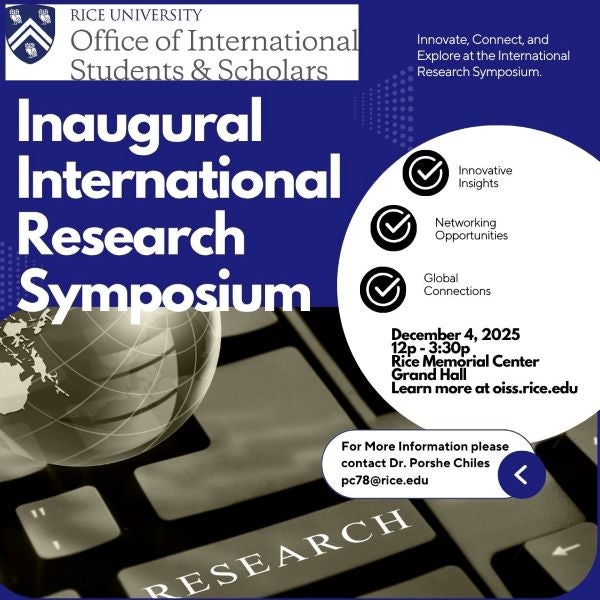
- Inaugural International Research Symposium
-
The Office of International Students and Scholars (OISS) is pleased to welcome you to the Inaugural OISS Research Symposium, to be held on Thursday, December 4, 2025. This event will highlight the diverse and innovative research conducted by international scholars at Rice University.
Meet The Researchers
- Fatma Zürnacı Yetiş
-
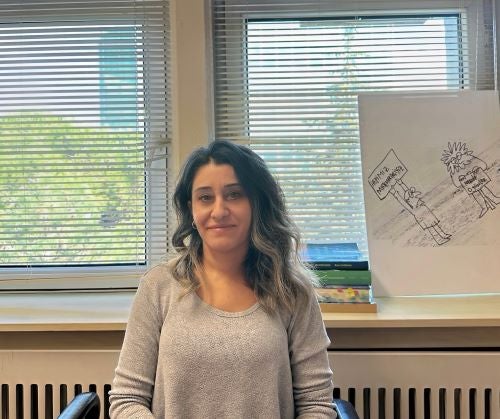
Fatma Zurnaci Yetis is a Research Assistant in the Department of Mathematics Engineering at Istanbul Technical University, Turkiye. She received her Ph.D. in 2022. She is currently a Visiting Scholar in the Department of Computer Science at Rice University. She is conducting her postdoctoral research project titled Quantum Splines under the supervision of Prof. Ron Goldman. This project is supported by the Scientific and Technological Research Council of Turkiye (TUBITAK). Her research interests include Computer Aided Geometric Design (CAGD), approximation theory, and special functions.
- Christian Sandoval Pauker
-
Christian received his Ph.D. in Chemistry from The University of Texas at El Paso in 2024, where he focused on computational investigations of transition metal photoredox catalysts. He earned his M.S. in Environment, Quality, and Prevention Management Systems from Universidad Internacional de la Rioja (2018) and his B.S. in Chemical Engineering from Escuela Politécnica Nacional (2016). He joined Rice University as a J. Evans Attwell Welch Postdoctoral Fellow in August 2024, supported by the Smalley-Curl Institute. His research in Prof. Thomas P. Senftle's group employs electronic structure methods to advance the development of photo- and electrocatalysts for removing perfluoroalkyl substances (PFAS) from water.
His research poster title is: Self-regenerating iron cycle enables efficient electrochemical oxidation and defluorination of PFAS using iron oxide electrodes

- Jieze 'Jesse' Zhang
-
His research poster title is: Molecular Basis on the Role of Matrix Proteins in the Replication Cycle of Deltainfluenzavirus
Highly pathogenic viruses have plagued humans for centuries, but our understanding of them on a molecular level is limited to only a few, such as the influenza viruses. Among these, the replication cycle of Deltainfluenzavirus (IDV), related to the infamous flu (Alphainfluenzazvirus, IAV), is unclear. While IDV doesn’t infect humans, it infects human lung cell lines and shows seropositivity in human populations, indicating a possibility for spillover. This project focuses on elucidating molecular mechanisms of the viral matrix proteins M1/M2 in IDV to highlight a diverse life cycle of nature’s undying parasites.
IDV M1 (DM1) is a peripheral membrane protein that stabilizes the viral genome and membrane, but the molecular basis of that interaction is unclear. Currently, I have identified key Arg/Lys residues involved in this process and shown that DM1 oligomerizes in the presence of nucleic acids. Through cryogenic electron microscopy (cryo-EM), I aim to determine the structure of DM1-dsDNA complexes to further define these interactions.
IDV M2 (DM2) is an integral membrane protein that conducts chloride ions. The IAV M2, a proton channel, acidifies the viral interior to activate viral glycoprotein conformational changes and fuses with the endosomal membrane for viral uncoating. Given the currently unclear role of DM2, I hypothesize that it conducts chloride ions into the viral interior that adjusts ionic strength to trigger viral uncoating. Currently, I have shown that DM2 is expressed as a glycosylated tetrameric membrane protein similar to other M2 proteins in the influenza viruses. Through pseudovirus model systems and cryo-EM, I aim to investigate the biochemical and structural properties of DM2.

- Maryam R. Faghihi
-
Maryam R Faghihi is a PhD candidate in Ecology & Evolutionary Biology at Rice University, focusing on speciation, sexual selection, and host-insect interactions. Her work integrates various methods to understand how new species evolve, choose mates, and interact with their environments.
Her research poster title is: Gall: Nature's Tiny Womb

- Ali Raza Sial
-
Ali Raza is a sophomore researcher in the Adams Lab at Rice University, specializing in electrocatalysis for two-electron oxygen reduction. His current work compares RRDE and GDE platforms to advance scalable H₂O₂ synthesis.
His research poster title is: Testing the Test: A Comparative Look at Catalyst Evaluation Techniques
Hydrogen Peroxide (H₂O₂) is a valuable oxidant with growing demand across industries for sustainable and on-site production. Electrocatalytic synthesis via the two-electron Oxygen Reduction Reaction (2e⁻ ORR) offers a cleaner alternative to the conventional anthraquinone process. This study evaluates the performance of a Gas Diffusion Electrode (GDE) setup for H₂O₂ electrosynthesis by benchmarking it against the well-established Rotating Ring-Disk Electrode (RRDE) technique.

- Marlene Fuhr
-
Her research poster title is: Multi-patient biophysical brain connectivity modeling with gray–white matter differentiation from stimulation-evoked potentials.
My research project, in collaboration with Baylor College of Medicine and ECE department at Rice, focuses on modeling brain connectivity in epilepsy patients undergoing intracranial monitoring. Using stimulation-evoked potentials, we build biophysically informed 3D conductivity maps of the brain. The goal is to capture how electrical signals propagate through gray and white matter, validated across multiple patients, to improve our understanding of neural pathways and support clinical applications such as epilepsy surgery and deep brain stimulation.
- Ehsan Aalaei
-
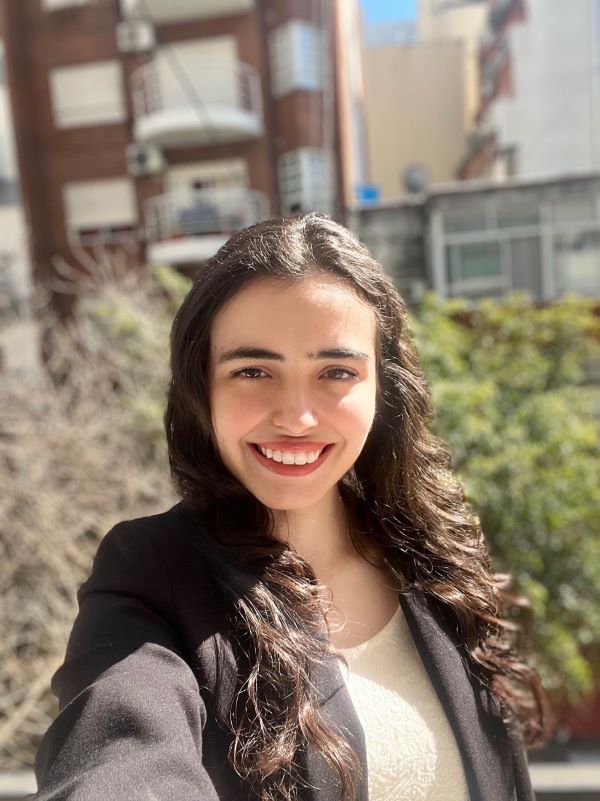
His research poster title is: Reusable Superhydrophobic Array Devices for Modeling Physiologically Relevant Microenvironments of Circulating Tumor Cells
Metastatic progression begins when cancer cells detach from the primary tumor, often a hypoxic microenvironment, and enter the bloodstream as circulating tumor cells (CTCs), eventually forming secondary tumors. These CTCs may circulate as single cells or as clusters, with the latter exhibiting enhanced resistance to fluid shear stress, immune evasion, and metastatic potential. However, due to their relative rarity in patient blood, CTC clusters remain poorly understood, emphasizing the need for robust and scalable in vitro models. To address this, the King Lab developed the Superhydrophobic Array Device (SHArD), which enhances cell–cell adhesion and enables high-throughput formation of CTC-like clusters and tumor spheroids. While effective, SHArD was originally designed for single use. In this study, we present a reproducible cleaning protocol that allows the device to be reused multiple times under both normoxic and hypoxic conditions, preserving its performance and cluster-forming capabilities.

- NASA Johnson Space Center
-
Join the Office of International Students and Scholars (OISS) for an exciting trip to the NASA Johnson Space Center, home to America’s astronaut training and mission control! Participants will have the opportunity to explore exhibits, learn about space exploration, and experience one of Houston’s most iconic destinations.
🚌 Transportation will be provided.
🎟️ Seats are limited—reserve your spot early!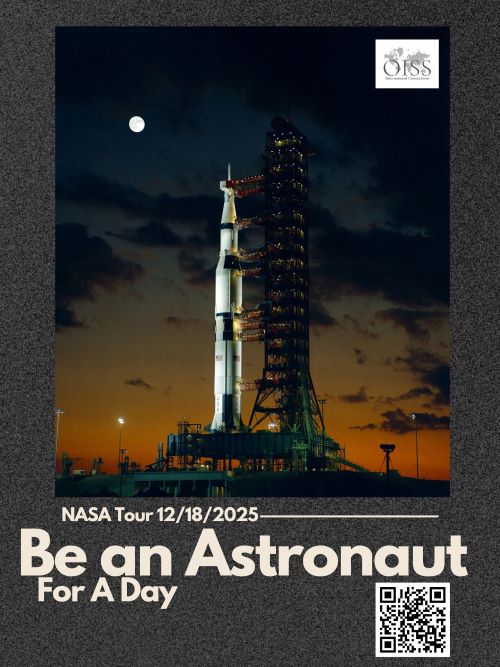
- SAVE THE DATE: Houston Rockets Game
-
Join the Office of International Students and Scholars (OISS) for an exciting Winter Program outing to see the Houston Rockets in action! Experience the energy of an NBA game, cheer with fellow Rice students, and enjoy one of Houston’s favorite pastimes.

For Summer Events in previous years, please click here.
For Winter Events in previous years, please click here.